Choosing among the top taping machines for boxes requires more than comparing speed ratings. Global buyers must examine carton sizes, tape widths, sealing pressure, power standards, maintenance access, and local service support. A Taping Machine For Boxes should close every carton firmly, even when corrugated surfaces vary slightly. That sounds simple. It is not.
Roberto Michel, a respected materials-handling analyst, notes, “The right machine balances throughput, uptime, and operator control.” This principle matters on busy packing lines. A machine running at 30 boxes per minute may look impressive. However, frequent jams can erase that advantage. Buyers should inspect the infeed belts, adjustable side guides, emergency stops, and tape-head design. Ask for a live demonstration using your actual cartons. Samples reveal more than brochures.
Operator experience also deserves attention. Clear controls reduce training time, while tool-free adjustments support quicker changeovers. Energy use, spare-part availability, and warranty response can influence long-term ownership costs. These details often receive less attention than headline performance. That is a mistake.
No single machine suits every market. Humid warehouses, dusty facilities, and mixed carton dimensions create different demands. Some buyers may also overestimate their future volume. A smaller semi-automatic model could offer better value today, while a fully automatic system may support planned growth. Careful evaluation remains essential. Reliable sealing comes from matching the machine to the real working environment, not choosing the most expensive model.
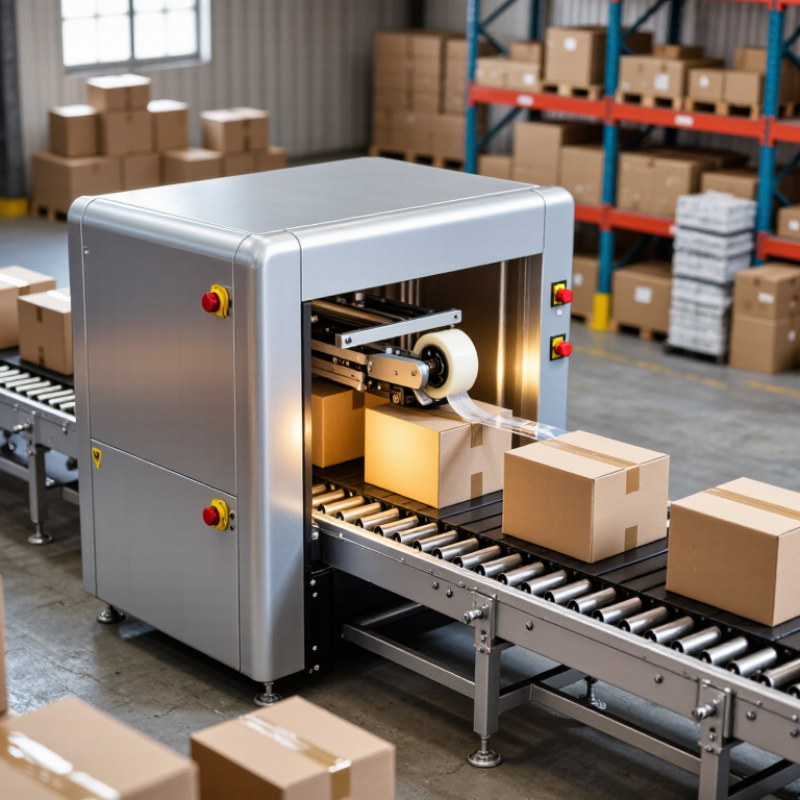
Box taping machines close corrugated cartons with pressure-sensitive tape. They are common in warehouses, factories, and e-commerce fulfillment centers. A machine usually folds the top flaps, applies tape, and presses the seal firmly. Operators can select semi-automatic or fully automatic models. The correct choice depends on carton sizes, line speed, and labor availability. Grand View Research valued the global packaging machinery market at about USD 42.2 billion in 2022. Its report also forecasts a 5.4% compound annual growth rate from 2023 to 2030. That growth reflects stronger automation demand, though every facility has different needs.
On a typical line, side belts guide the box forward. Sensors detect its position and height. A tape head unwinds the roll, cuts the tape, and presses it across the center seam. Some systems seal only the top. Others handle both top and bottom flaps. Pressure settings matter. Too little pressure leaves lifting edges. Too much pressure can crush light cartons. PMMI’s 2024 State of the Industry reporting identifies labor availability and automation investment as continuing packaging priorities. Still, automation is not effortless. Dust, uneven flaps, and poor carton quality can interrupt production.
Tips: Measure your smallest and largest cartons first. Check tape width, core size, and sealing temperature requirements. Run real cartons during testing, not empty samples. Record jams for one week. That small record may reveal a larger setup problem. I would also leave operator access around the tape head. Maintenance becomes difficult when space disappears.
| Machine Type | How It Works | Typical Box Range | Typical Speed | Tape Specification | Power and Air Requirements | Best Applications | Main Advantages | Key Limitations |
|---|---|---|---|---|---|---|---|---|
| Manual Handheld Taping Tool | The operator places the tape over the carton seam, pulls the tape across the box, and cuts it with the integrated blade. | Most carton sizes; suitable for irregular or frequently changing dimensions. | Approximately 8–15 boxes per minute, depending on the operator and carton size. | Commonly uses pressure-sensitive BOPP or PVC tape from approximately 48–75 mm wide. | No electrical power or compressed air required. | Low-volume packingRetail roomsMaintenance areas | Low purchase cost, portable design, simple operation, and minimal maintenance. | Labor-intensive; sealing consistency and output depend on operator skill. |
| Semi-Automatic Uniform-Case Sealer | The operator squares and positions the carton. Powered side belts transport the box while upper and lower tape heads seal the center seams. | Typically about 150–500 mm in length, 120–500 mm in width, and 120–500 mm in height; exact ranges vary by configuration. | Approximately 15–25 boxes per minute. | Usually 48–75 mm pressure-sensitive tape; common roll lengths are selected according to the tape head and production needs. | Commonly powered by a single-phase electrical supply; compressed air is generally not required for basic models. | Small warehousesE-commerceUniform cartons | Improves sealing consistency and productivity while keeping the operator involved in carton preparation. | Requires reasonably consistent carton dimensions and manual carton positioning. |
| Semi-Automatic Random-Case Sealer | Adjustable guides and sensing systems detect carton height and width, then automatically position the sealing heads for each box. | Handles a range of carton sizes without manual handwheel adjustment between every box; working limits depend on the model. | Approximately 15–25 boxes per minute. | Commonly compatible with 48–75 mm pressure-sensitive tape. | Usually requires electrical power; some configurations use compressed air for pneumatic adjustments. | Mixed-SKU fulfillmentVariable cartonsDistribution centers | Reduces setup time and supports cartons with changing dimensions. | Higher cost and greater adjustment complexity than uniform-case equipment. |
| Fully Automatic Uniform-Case Sealer | A powered conveyor receives erected cartons, automatically folds or closes the top flaps, and applies tape to the top and bottom center seams. | Designed for a defined carton-size range, commonly around 150–500 mm in length and width, subject to machine configuration. | Approximately 20–35 boxes per minute. | Typically uses 48–75 mm pressure-sensitive tape with compatible industrial tape heads. | Usually requires electrical power; pneumatic flap-folding features may require compressed air. | Continuous productionManufacturingStandard cartons | High throughput, repeatable sealing quality, and reduced manual handling. | Needs a stable carton supply, accurate case dimensions, and a suitable conveyor layout. |
| Fully Automatic Random-Case Sealer | Sensors measure carton dimensions while powered belts and adjustable sealing heads automatically adapt to each incoming box. | Supports mixed carton sizes within the machine's specified minimum and maximum limits. | Approximately 15–30 boxes per minute, depending on carton variation and line layout. | Commonly uses 48–75 mm pressure-sensitive tape. | Requires electrical power; compressed air may be needed for pneumatic controls or flap-folding assemblies. | High-mix fulfillmentParcel distributionContract packing | Handles variable cartons with limited operator intervention and reduces manual changeovers. | Higher investment, more sensors and moving parts, and greater maintenance requirements. |
| Top-and-Bottom Belt Case Sealer | Two powered side belts stabilize and transport the carton while upper and lower tape heads apply tape simultaneously to the top and bottom seams. | Best for regular corrugated cartons within a fixed or adjustable size range. | Approximately 15–30 boxes per minute. | Usually uses pressure-sensitive carton-sealing tape in widths of approximately 48–75 mm. | Normally electrically powered; compressed air depends on the flap-closing and adjustment system. | Heavy cartonsPallet preparationIndustrial packing | Provides stable transport, balanced sealing, and good support for heavier cartons. | Requires adequate floor space and accurate carton alignment for reliable operation. |
| Side-Belt Case Sealer | Side-mounted belts grip the carton and move it through fixed or adjustable top and bottom sealing heads. | Suitable for cartons that can be supported securely by side belts; commonly used with medium and large boxes. | Approximately 18–30 boxes per minute. | Commonly uses 48–75 mm pressure-sensitive tape. | Electrical power is required; pneumatic equipment is optional depending on the design. | Medium cartonsGeneral manufacturingWarehouse lines | Good carton stability, smooth transport, and suitability for many standard production lines. | May be unsuitable for very narrow, unstable, lightweight, or severely overfilled cartons. |
| Hot-Melt Carton Sealer | The machine applies heated adhesive to carton flaps and compresses the flaps until the adhesive bonds. | Works with compatible corrugated cartons; carton flap design and adhesive selection are important. | Approximately 10–25 boxes per minute, depending on carton size and adhesive system. | Uses hot-melt adhesive rather than pressure-sensitive tape. | Requires electrical heating power; compressed air may be used for pneumatic mechanisms. | Tamper-resistant packsHigh-volume shippingTape reduction | Strong closure, no tape roll changes, and compatibility with some automated packaging lines. | Requires heat management, adhesive maintenance, and appropriate operator safety procedures. |
| Stainless-Steel or Washdown Case Sealer | Uses a standard belt-and-tape-sealing process, with corrosion-resistant construction and protected components for frequent cleaning. | Carton range is based on the selected sealing mechanism; commonly configured for regular production cartons. | Approximately 10–25 boxes per minute. | Usually uses 48–75 mm pressure-sensitive tape selected for the operating environment. | Electrical power is required; pneumatic options vary by configuration. | Food packagingPharmaceutical logisticsMoist environments | Improved resistance to corrosion and easier cleaning than standard painted-steel construction. | Higher purchase cost; tape, bearings, sensors, and electrical parts still require routine protection and inspection. |
Note: Performance ranges are typical industry values for comparison. Actual speed, carton dimensions, tape compatibility, power supply, and compressed-air requirements depend on the machine configuration, carton quality, tape material, and production-line layout.
It closes corrugated cartons with pressure-sensitive tape. The machine folds flaps, applies tape, and presses the seal firmly.
Side belts move each carton forward. Sensors detect its height and position. A tape head cuts and presses tape across the center seam.
Semi-automatic machines suit smaller operations and changing carton sizes. An operator folds the flaps and guides each box. Fully automatic models fit stable lines with repeatable carton dimensions. Labor savings can be real, but not every facility needs maximum automation.
It suits packaging lines handling different carton sizes. Sensors adjust the sealing position automatically. This helps mixed e-commerce orders. Adjustable equipment costs more and needs stronger maintenance skills.
Some machines seal only the top. Others seal both top and bottom flaps. Confirm this requirement before purchasing. A small specification mistake can create daily rework.
Test real cartons, not empty samples. Record cartons per minute during size changes and interruptions. A machine rated for 30 cartons per minute may run slower with uneven boxes. Speed figures can mislead.
Measure the smallest and largest cartons. Record length, width, height, weight, and flap condition. Check tape width and core size. Leave clear access around the tape head.
Dust, uneven flaps, poor carton quality, and incorrect tape tension can cause jams. Too little pressure lifts the tape edges. Too much pressure may crush light cartons. Problems become obvious.
Record every jam for one week. Note the carton size, tape roll, and time of failure. This simple record may expose a larger setup problem. I would also keep tools and operators away from blocked access points.
A Taping Machine For Boxes is designed to seal cartons quickly, consistently, and securely by applying adhesive tape along the top, bottom, or both surfaces of a box. Depending on packaging needs, buyers may choose manual, semi-automatic, or fully automatic models, with different options for occasional use, varied carton sizes, or high-volume production. Important features include adjustable box dimensions, sealing speed, tape width compatibility, sturdy construction, safety protection, easy controls, and reliable performance.
Global buyers should compare machine capacity, energy use, purchase cost, maintenance requirements, spare-part availability, and compatibility with existing packaging lines. Proper installation requires a stable surface, suitable power supply, correct adjustment, and operator training. During use, cartons should be positioned accurately and kept within the machine’s size range. Regular cleaning, tape replacement, lubrication where appropriate, inspection of moving parts, and prompt troubleshooting can extend service life, improve sealing quality, and support efficient daily operations.

 Huisu Smart