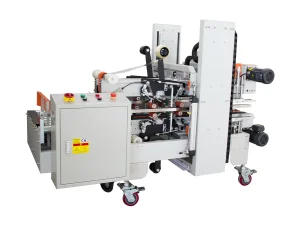
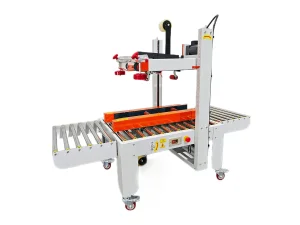
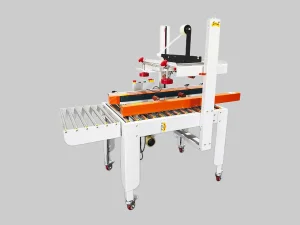
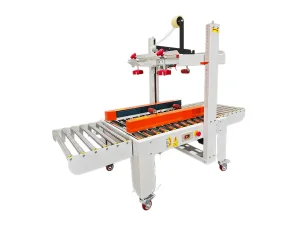
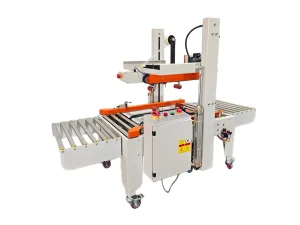
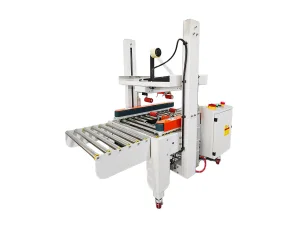
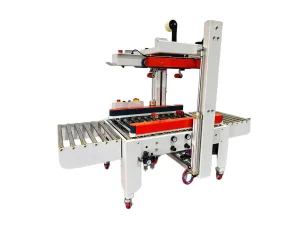
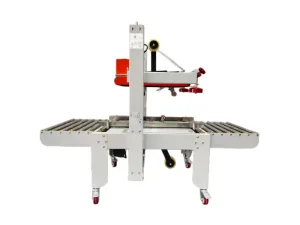
Optimized configurations engineered for Japanese manufacturing footprint restrictions and high throughput demand.
Whitepaper detailing the technical dynamics of Tokyo's end-of-line packaging infrastructure.
As the primary economic hub of Japan, the Greater Tokyo Area hosts one of the world's most dense concentrations of high-efficiency logistics distribution networks, cold chain facilities, and high-tech manufacturing plants. In recent years, challenges such as labor shortages in the transport and warehouse sectors—commonly known in Japan as the "2024 Logistics Problem"—have forced industries to quickly transition from manual processes to automation. High-speed, highly reliable carton sealing machinery has become critical to maintaining operational efficiency in regional distribution hubs in areas like Koto-ku, Ota-ku, Yokohama, and Kawasaki.
Real estate costs in prime metropolitan zones demand industrial systems that offer maximum output within a minimal footprint. Modern carton sealing equipment must be modular, fit into limited physical spaces, and integrate with existing conveying systems without major layout changes.
Operating machinery in Eastern Japan requires compliance with localized electrical standards. Tokyo operates on a 50Hz frequency grid with standard single-phase 100V and three-phase 200V configurations. Our equipment series is designed with dual-frequency tolerance and can be fitted with specialized components to ensure full electrical compliance under Japanese PSE (Product Safety Electrical Appliance & Material) guidelines, as well as CE certifications.
Worldwide supply chains are increasingly shifting toward automated smart packaging lines. E-commerce platforms, food exporters, and pharmaceutical distributors require high throughput speeds as well as clean, precise tape application that secures contents while minimizing material waste. Using high-quality BOPP and kraft paper tapes alongside specialized tape heads reduces tape jams and machine downtime, helping facilities maintain continuous daily operation.
Delivering reliable, energy-efficient and cost-effective packaging solutions to global manufacturers and distributors.
An engineering analysis to help you select the right mechanical drive for your packaging line.
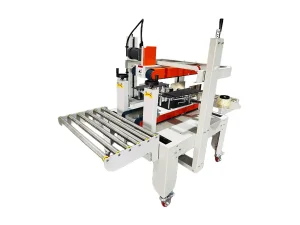
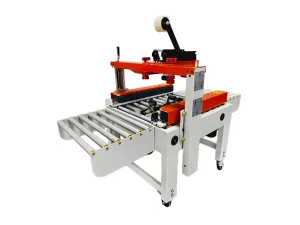
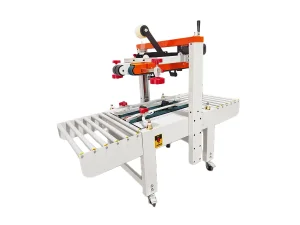
Side-drive systems utilize two bilateral motorized belts to clamp the sides of the carton and pull it through the taping head. This mechanism is best suited for cartons that are relatively short, wide, or lightweight. By applying lateral force, it prevents crushing thin-walled boxes and ensures stable movement for flat packages.
Top-bottom drive systems use belts positioned above and below the carton path. This provides vertical clamping force and traction. It is recommended for tall, narrow, or heavy boxes that could tip or wobble if pushed from the sides. The dual-motor drive ensures steady feeding even with unbalanced weight distributions.
Customizing automated systems to meet specific operational requirements for Tokyo's industrial sectors.
Evaluation of box sizes, tape material, throughput speeds, and local voltage specs.
Custom modular configuration and placement matching for line integration.
Extensive trial runs with client carton sizes under continuous load cycles.
Rigorous multi-point testing matching ISO9001 and CE protocols.
Secure packaging, sea/air shipping coordination, and 24/7 technical backup.
Combining high-quality raw materials with advanced mechanical engineering.
Our mechanical engineering team has more than 20 years of experience, and our electrical control engineers focus on developing advanced PLC and human-machine interface (HMI) systems. The product portfolio includes automatic carton erectors, carton sealers, strapping systems, stretch wrappers, and robotic palletizing units. These systems are widely used in food processing, pharmaceutical production, hardware packaging, and consumer electronics fulfillment globally.
By using modular chassis design, hardened steel frames, stainless steel guide rollers, and durable drive belts, Huisu machines help operators lower labor requirements, speed up packaging processes, and minimize downtime. Our customized turnkey systems integrate smoothly into existing assembly lines, providing reliable performance and helping businesses operate more cost-effectively.
Technical details regarding application, installation, customization, and regional operation.
Select from our complete line of automatic and semi-automatic carton sealing equipment designed for various industrial applications.
 Huisu Smart